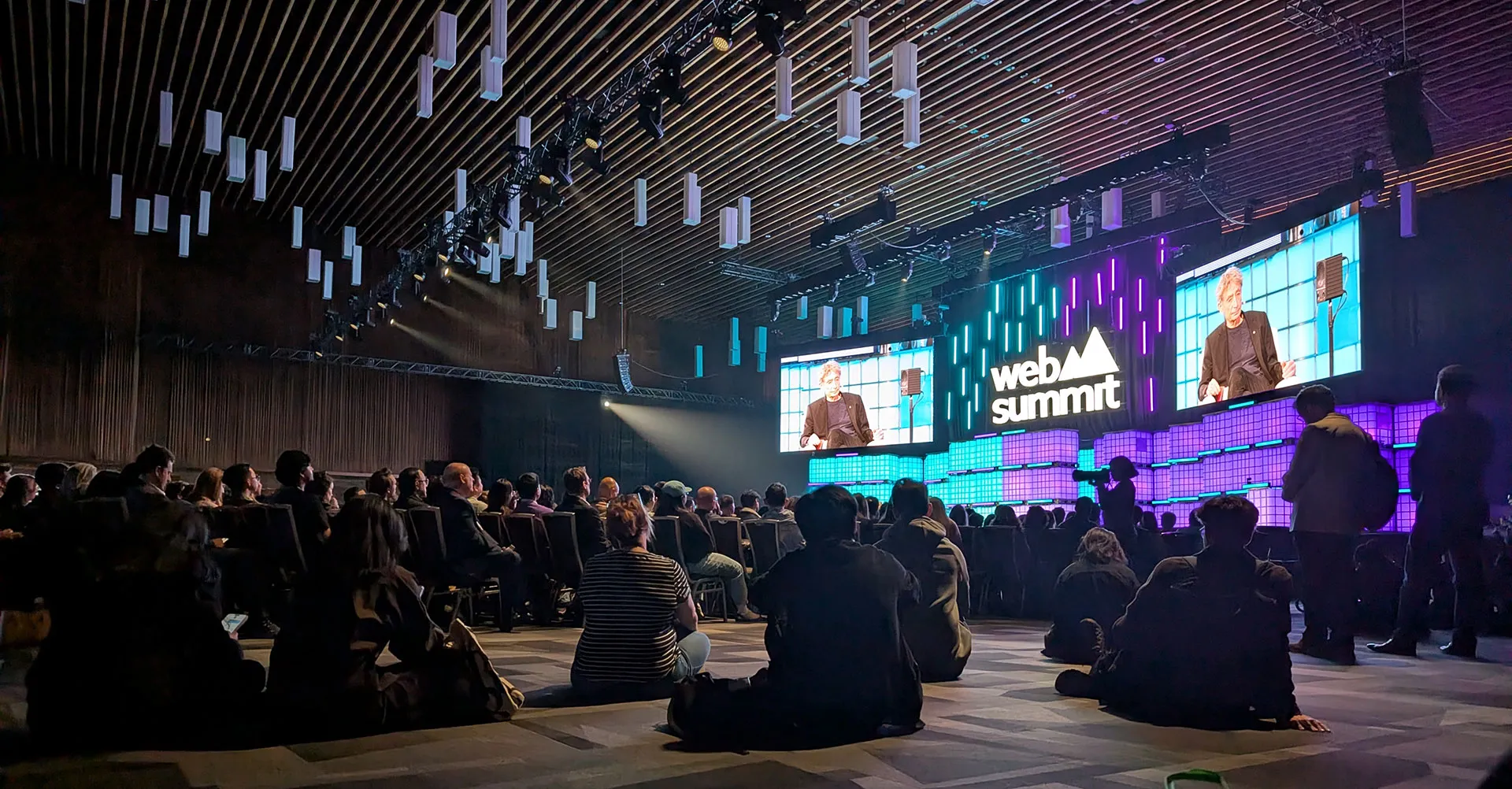
Attending a massive tech conference can feel like stepping into a time machine. You get an immediate look at where the world is heading over the next few years.
This month, Kristina and I headed to the Vancouver Convention Centre for our second consecutive year at WebSummit Vancouver.
If we had to sum up the experience in a single word? Immersive. As an agency rooted in building intentional, purpose-driven digital systems, we walked onto the floor looking past the bright lights and slick presentations to find what truly matters: How is this technology actually going to serve small and medium-sized businesses?
Here is what went down at one of North America’s largest tech gatherings, what it feels like on the ground, and why this year felt fundamentally different for startups.

What is WebSummit?
WebSummit Vancouver (formerly known as Collision Conference in Toronto) is a massive magnet for global innovation. It serves as a crossroads where international entrepreneurs, venture capitalists, and cultural icons meet to map out the next wave of the digital economy.
The sheer scale of the event is impressive. To put it into perspective, the official stats for the event highlighted just how massive this gathering has become:
- 20,000+ attendees converging from over 100 countries (a massive 29% jump from last year).
- 1000+ startups showcasing cutting-edge software and platforms.
- 750+ venture capital investors on the hunt for the next unicorn.
The On-the-Ground Experience: High Energy & No-nonsense Insights
Walking onto the exhibition floor, the energy was almost overwhelming. Thousands of people, endless rows of booths, and a non-stop hum of pitches and networking. But once you look past the sheer volume of the crowd, a fantastic mix of raw innovation emerges.
So how do you start doing this? Well, there is no shortage of great resources for developing training programs or companies dedicated to helping create operating systems and manuals. But if you want to start small, here are a few simple things you can do:
Two things stood out to us above all else this year:
1. AI is Democratizing the Startup Ecosystem
The barrier to entry for launching a tech startup has been lowered. Walking the floor, it was incredibly clear that Artificial Intelligence is the great equalizer. Emerging startups are utilizing AI to build faster, automate complex processes, and scale operations with a fraction of the capital previously required. Ideas that once required millions in seed funding to build a prototype are now being brought to life by small, agile teams.
2. Deep, Incisive Conversations
Sometimes, major tech panels can feel like a series of rehearsed PR statements. Not here. This year, the moderators clearly did their homework. They asked incredibly poignant, deep questions, steering the conversations away from generic buzzwords and pushing speakers to give real, actionable answers. It made the presentations remarkably grounded and highly valuable for those of us sitting in the audience, looking for actual business insights.
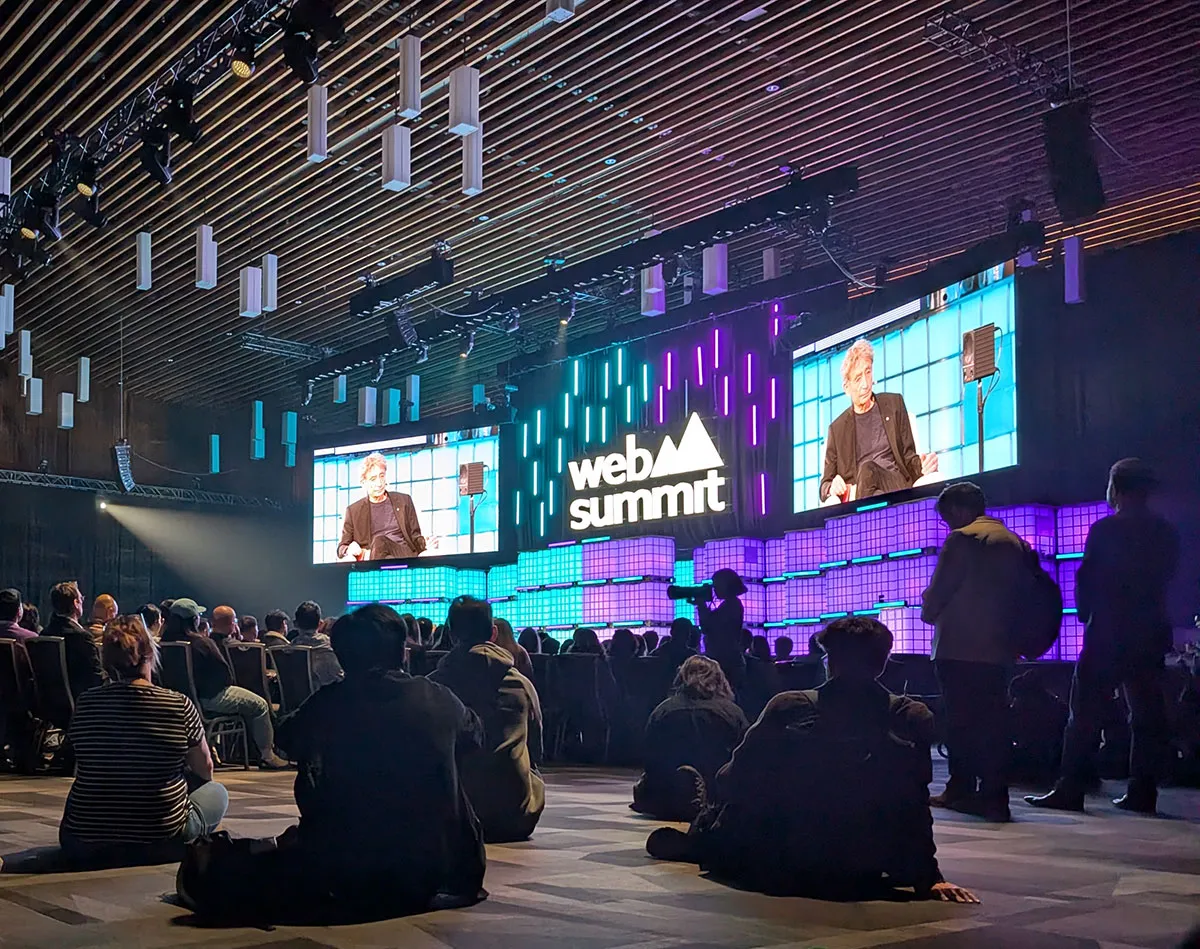
Key Takeaways: Moving Past the Hype to Real-World AI Reality
Sitting through the presentations, I noticed a distinct shift in tone from the previous year. The conversations have moved away from starry-eyed wonder and toward a grounded, highly critical evaluation of how AI actually functions in a business environment.
Kristina and I took pages of notes, but the overarching theme was clear: AI is a powerful catalyst, but it requires a heavy dose of human guardrails. Here are the macro tech trends and core takeaways dominating the presentations this year:
1. The Real Capabilities (and Limits) of the Tech
- Approximation Over Autonomy: AI is a world-class tool for approximation, pattern recognition, and speed. However, panels repeatedly stressed that it is not yet ready to act as fully autonomous agents. Expecting it to run parts of your business unsupervised is a recipe for error.
- The Importance of Context Models: A generic AI tool yields generic results. To make AI truly work for your specific needs, you must build a robust context model. The AI needs a deep, structured understanding of exactly what your specific organization does and how you do it.
- Goal-Oriented Prompting: The way we interact with these systems is evolving. Prompting needs to be goal-oriented and interloptive (collaborative and conversational) rather than deterministic (expecting a rigid, single-line input to yield a perfect final product).
2. The Rise of "Workslop" (And Why it's Killing Productivity)
- The Danger of Directionless AI: Pushing a team to use AI simply for the sake of saying "we use AI" is a trap. Without clear direction, intentional guardrails, and proper training, this corporate pressure results in what a seminal Harvard Business Review article terms "AI-Generated Workslop."
- The Cost of Slop: Workslop occurs when an employee uses AI to quickly churn out a low-effort, polished-looking report or email that lacks actual substance. It essentially offloads the cognitive labor onto the recipient.
- The Downstream Fallout: According to the HBR study, workslop doesn't save time. Instead it shifts the burden downstream, costing coworkers hours of rework. This increases interpersonal friction, rapidly erodes team trust, and promotes non-socially desirable behavior in the workplace.
The Takeaway: Workslop is fundamentally a management failure, not a technology failure. Organizations must combat this by focusing heavily on Reinforced Learning with Human Feedback (RLHF) to ensure quality control stays firmly in human hands.
3. De-Platforming and the New Software Ecosystem
- Broadening the Tool Ecosystem: Historically, businesses have been forced to lock themselves into massive, rigid Enterprise Resource Planning (ERP) systems or giant platforms because that’s where the native plugins lived.
- Seamless Workflow Optimization: AI makes connecting disparate software tools and optimizing complex workflows significantly easier.
- The Freedom to Unbundle: For our clients, this is a massive win. It means businesses can finally move away from restrictive, one-size-fits-all platforms that excel in one area but drop the ball in another. AI allows you to build a bespoke tech stack of specialized tools that communicate with each other flawlessly.
4. Marketing, Branding, and The Flattening Aesthetic
- The Funnel is Widening: In the marketing space, AI is incredibly effective at widening the discovery portion of the funnel, enabling highly targeted ads, and driving higher conversion rates. In the e-commerce sector specifically, highly specialized, hyper-contextual onsite AI chat agents are poised to dominate.
- The "Flattening" Aesthetic: There is a dark side to algorithmic creativity. Because AI trains on existing data, it is rapidly flattening the global aesthetic. Content, design, and copy are beginning to look and feel the same across industries, making it significantly harder for brands to organically stand out.
- The Need for Deep Identity: Because a flashy visual identity can now be generated in seconds, superficial branding is dead. Brands need to deepen their core identity more than ever. Success requires clear messaging and a profound company ethos; a shallow brand identity will quickly get lost in the noise.
- Human Discernment is Non-Negotiable: At the end of the day, organizational rigidity prevents true creativity. Human discernment is still vitally required, especially when analyzing customer feedback and navigating authentic product development. Outsourcing your thinking to AI must be done with extreme discretion.
The SMB Playbook: How to Build an "AI-Native" Business (Without the Slop)
For small and medium-sized businesses (SMBs) and startups, the temptation to jump headfirst into every new AI tool is real. But if WebSummit taught us anything, it’s that slapping AI onto an inefficient process just gives you a faster, more expensive inefficient process.
To win in this new landscape, businesses need to transition from merely using AI to becoming AI-Native.
Being AI-native doesn't mean replacing your team with robots. It means rewriting your operational framework to understand exactly where AI can act as a catalyst, and developing systems around that capability rather than letting it sit randomly on top.
1. Stop Guessing: Audit Your Workflows for True AI Gaps
Becoming AI-native requires intention. Instead of adopting a tool because it's trending, look deeply at your existing systems. Where are the friction points? Where are the data silos?
Use AI strategically to bridge gaps and optimize your existing workflows, not as a random experiment hoping it magically fixes a broken business model.
2. The Golden Rule: AI Upskills the Expert, but Exposes the Novice
It’s true that AI has "upleveled" everyone’s baseline capabilities. Suddenly, anyone can write a script or generate a marketing plan. But because the market is now flooded with cheap, fast content and products, human discernment is the ultimate competitive advantage.
The most successful AI users aren't the ones who know the "secret prompts" - they are the people who possess a deep foundational knowledge of their domain.
- The Expert Advantage: If you understand your industry deeply, you can effectively verify the AI’s output, spot hallucinations, steer the context, and prompt with precise intent.
- The Autopilot Trap: If you don't understand the core fundamentals, you are trapped on autopilot. Relying blindly on AI leads straight to the "workslop" we talked about above.
To survive, teams must continue to challenge assumptions, learn deeply, and use their expertise to judge product direction and genuine user needs. Human discernment is what will ultimately separate the startups that scale from the ones that sink.
3. A Look Inside Our Tech Stack: How We Use AI Realistically
We intentionally protect our creative and strategic thinking by offloading administrative friction to AI.
Here is exactly how we practically leverage AI in our daily operations to drive efficiency without losing quality:
- Meeting Mastery & Summaries: We use AI to take comprehensive notes during meetings and provide concise summaries. This allows us to stay 100% present with clients and team members instead of frantically typing.
- Unbundling Our Software Stack: When we want to use specialized tools that don’t naturally talk to each other, we use AI to help bridge the code gaps and link tools that don't connect natively.
- Rapid Prototyping & Approximations: Before committing hours to a concept, we use AI to give us quick, low-cost visual or textual approximations for designs and content. It acts as a digital sandbox for our initial ideas.
- Accelerated Research: When entering a new niche or analyzing a fresh market segment, AI helps us rapidly digest and synthesize high-level research so we can get up to speed in a fraction of the time.
- Data & Analytics Presentation: We use AI to help clean, format, and structure complex analytics data into clear, visual presentations that our clients can easily understand.
Startups to Watch: The Innovators Who Stole the Show
With over a thousand startups exhibiting at WebSummit Vancouver, standing out was no easy feat. Especially true in an era where algorithmic aesthetics can make many companies look identical.
However, we crossed paths with several founders and teams who aren't just using tech for the sake of the hype. They are solving deeply fragmented, real-world problems, advancing sustainability, and leading with authentic human vision.
Here are the seven startups we walked away completely inspired by:
1. OceanAid (oceanaid.ca)
It was incredibly inspiring to see how AI can be deployed as a force for global good. OceanAid is utilizing advanced technology to protect marine ecosystems and help the environment. They are a breath of fresh air and a stellar example of how high-tech automation can be directed toward ecological conservation.
2. VoxCell BioInnovation (voxcell.com)
VoxCell is an absolute powerhouse when it comes to demonstrating how AI can accelerate development in the biotech space. By creating tissue-like structures to mimic human oncology models, they are streamlining the drug development process. They are proof that AI-native frameworks can quite literally help save human lives by eliminating research bottlenecks.
3. SupportBench (supportbench.com)
Customer service software can easily feel cold and algorithmic, but SupportBench is completely reimagining the support and documentation space. Instead of using AI to build annoying, unhelpful chatbots that alienate users, they are seamlessly integrating AI to empower customer support teams, improve data synchronization, and deepen user trust.
4. Theona AI (theona.ai)
As an agency focused on operations and business analysis, this one hit close to home. Theona AI focuses on fast process documentation and automated recommendations. In the past, mapping out process discovery used to take our team weeks of labor, requiring multiple exhausting interviews with various stakeholders. Theona AI automates that operational heavy lifting in a fraction of the time.
5. Edwyyn (edwyyn.com)
While Edwyyn is a pre-construction software system still in the making, we were incredibly impressed by the founder and their overarching vision. Having worked in the construction sector ourselves, we know firsthand just how fragmented, siloed, and inherently stressful the bidding and pre-construction phase can be. Keep an eye on this one - they are tackling a massive, old-school industry pain point head-on.
6. Sidian (sidian.io)
Sometimes, a startup stands out purely because of the grit and passion of its people. We absolutely loved the reps from Sidian who came out to the event. They have built a highly adaptable product that can be pivoted and applied across multiple diverse sectors, and their team’s energy was completely infectious.
7. Conscious Collective (giftwithstory.com)
A truly wonderful company with a beautiful story. The founders are incredibly lovely people, and we found ourselves deeply aligning with their vision. In a corporate world flooded with cheap, throwaway plastic swag, Conscious Collective is paving the way for sustainable, intentional, and genuinely meaningful corporate gifting.
Final Thoughts: The Future Belongs to the Discerning Builders
WebSummit Vancouver proved that the "build it cheap and fast" era of AI is hitting its peak. Moving forward, the companies, startups, and SMBs that thrive won’t be the ones that rely entirely on autopilot. Success will belong to those who pair powerful AI systems with deep industry knowledge, strict quality control, and an unshakeable human ethos.
We left Vancouver inspired, full of ideas for our clients, and ready to keep building intentionally. See you next year, WebSummit.